


Every finance leader knows the challenge. Sales tax compliance drains resources, adds complexity, and too often leaves companies exposed to penalties or overpayments. Staff spend hours chasing exemption certificates, researching multi jurisdiction tax rules, and preparing returns—only to face errors when rules change or documentation is incomplete.
The obvious question becomes: what is the return on fixing this with sales tax automation?
That is where CereTax comes in. As a next generation provider of sales tax software, CereTax delivers automation that is accurate, scalable, and measurable. With rooftop level GIS accuracy and built in exemption certificate management, CereTax helps manufacturers and distributors cut costs, reduce risk, and prove ROI with real numbers.
The Sales Tax ROI Calculator shows you exactly how much you stand to gain. By translating hidden compliance costs into hard data, it makes the business case for automation clear.
At its core, the calculator pulls together four categories of measurable savings:
1. Staff hours saved
2. Error reduction
3. Overpayment prevention
4. Audit efficiency
Each of these categories has a dollar value attached. Add them together, subtract the cost of the software, and you have your ROI.
To get accurate results, you need baseline data. Here are the inputs a manufacturer or distributor should collect:
With these numbers, the calculator can produce a concrete estimate of annual savings.
Let’s walk through an example.
Company profile: 250 employees, operations in 8 states, 600 active exemption certificates.
Total annual tax cost without automation = 73,400 dollars
With CereTax sales tax automation in place, the company cuts staff time by 70 percent, eliminates most penalties and overpayments, and streamlines audits.
Total annual savings with software = 55,700 dollars
If the sales tax software investment is 25,000 dollars per year, the ROI is more than 2 to 1 in the first year alone.
The ROI Calculator makes the case in black and white. Instead of vague efficiency claims, you have:
This turns sales tax software from a “nice to have” into a strategic investment that pays for itself.
Manufacturers would never buy new equipment without running the ROI. Sales tax software should be treated the same way. A Sales Tax ROI Calculator gives finance leaders the numbers they need to make confident decisions.
With CereTax, the savings are not hypothetical. They are measurable, repeatable, and tied directly to smarter automation.
Want your custom ROI breakdown? Let’s run the numbers together.
How accurate is the ROI Calculator
It depends on the data you provide. The more detailed your staff hours, penalties, and overpayments, the more precise your ROI projection will be.
Can the calculator handle multi jurisdiction tax compliance
Yes. The tool accounts for the added complexity of multi jurisdiction operations, where varying state and local rules often drive the highest hidden costs.
What about exemption certificate management
Certificates are one of the largest sources of audit exposure. CereTax automates the entire lifecycle, ensuring certificates are valid, current, and easy to retrieve.
How does GIS accuracy improve ROI
Most providers still rely on zip code lookups. CereTax uses rooftop level GIS accuracy to apply the right tax rate every time. That prevents overpayments and reduces audit adjustments.
Is ROI a one time calculation or ongoing
ROI should be reviewed annually. As transaction volumes grow and operations expand, the return on sales tax software typically increases.
Take this ROI Calculator with you. Share it with your team or keep it handy for quick reference.
Every business transaction leaves a tax footprint. For taxable sales, that footprint translates into a sales tax obligation. The challenge is making sure that obligation is calculated and applied correctly.
Yet most sales tax engines still rely on zip codes to determine rates. On the surface, that sounds logical. After all, a zip code points to a geographic area. But in practice, it is a blunt instrument. Zip codes were built for mail delivery, not sales tax jurisdiction accuracy.
The result is exposure. If you are relying on zip code logic, you are at risk of over-collecting, under-collecting, or misapplying sales tax. And regulators do not forgive errors just because your system was imprecise.
This is where Geographic Information Systems, better known as GIS, change the game. By pinpointing the exact rooftop location of a transaction, GIS-based engines bring precision to sales tax calculation and compliance that zip codes cannot match.
Zip codes cover broad areas. A single zip code can span multiple cities, counties, and even school or special tax districts. Within those boundaries, tax rates and rules can vary widely.
Imagine a telecom company serving customers across state lines, or a manufacturer delivering equipment to clients in multiple jurisdictions. If you use zip codes as your guide, you may apply the wrong tax rate. Sometimes it is pennies per transaction. But scale that across thousands or millions of invoices, and you are looking at material exposure.
Auditors know this. They see zip code-based tax engines as low-hanging fruit. If your system is off, penalties and interest are only the beginning. The reputational cost with customers and stakeholders is often worse.
GIS technology uses precise geographic coordinates to map a transaction to the correct sales tax jurisdiction—right down to the rooftop. Instead of relying on the assumption that an entire zip code shares the same rate, GIS calculates based on where the transaction actually occurred.
Here is why rooftop accuracy matters:
Telecom sales tax is among the most complex in the country. Services cross multiple jurisdictions in a single bundle: voice, data, streaming, managed services. GIS ensures you apply the right sales tax rules to each component, no matter how granular the service area. Without rooftop accuracy, telecom providers risk misallocating sales tax across entire customer bases.
Manufacturers move goods across county and state lines daily. Zip code logic cannot keep up with the complexity of delivery addresses, drop shipments, and direct-to-consumer sales. GIS enables precise situsing, so you know which jurisdiction should receive sales tax and which exemptions apply. It protects you from double taxation and keeps exemption management clean.
For retailers, customer experience is on the line. Over-collecting sales tax makes you look sloppy. Under-collecting leaves you exposed. GIS provides rooftop-level precision for every transaction, whether it is in-store pickup, home delivery, or interstate shipping. That accuracy scales seamlessly with ecommerce growth.
This is not just about avoiding errors. GIS is about shifting from reactive compliance to proactive strategy. By implementing rooftop-level accuracy, you:
Legacy engines built on zip codes are relics of another era. Modern business demands modern sales tax technology. GIS is not a luxury. It is the new baseline for compliance.
If you are still using zip code-based sales tax determination, you are leaving yourself open to risk. GIS rooftop accuracy closes that gap.
The companies that embrace it are not just avoiding penalties. They are unlocking efficiency, accuracy, and confidence in every jurisdiction they touch. That is the future of sales tax automation—and it is already here.
Ready to Eliminate Sales Tax Guesswork? CereTax combines rooftop-level GIS precision with built-in safeguards that catch and resolve issues before they become risks.
What is GIS in sales tax?
It is a system that maps a transaction to its exact rooftop location to determine the correct sales tax jurisdiction.
Why is zip code-based sales tax risky?
Zip codes span multiple tax jurisdictions, making sales tax calculations error-prone and audit risky.
Does GIS improve exemption management?
Yes. It ensures exemptions are applied correctly at the jurisdictional level, avoiding misapplication.
Who benefits from GIS in sales tax?
Any business with multi-jurisdiction transactions: telecom, manufacturing, retail, or ecommerce.
How does GIS reduce sales tax audit risk?
By providing defensible, rooftop-accurate sales tax calculations that auditors cannot easily challenge.
Walk through any factory floor and you will see the value of preventive maintenance. Machines are inspected, tuned, and repaired before small issues become costly breakdowns. Everyone understands the logic: a little discipline today avoids a major shutdown tomorrow.
Sales tax exemptions deserve the same mindset. For many manufacturers, exemption certificates are collected once, filed away, and forgotten. That works fine until the day an auditor shows up. Suddenly what felt like paperwork becomes a liability. Penalties pile up, staff are pulled from production to dig through records, and your business looks disorganized in front of regulators.
The truth is simple: exemption management is not busywork. It is risk management. And just like preventive maintenance, the companies that treat it seriously stay ahead of problems. The tool that makes this possible is a sales tax exemption audit kit.
On paper, exemptions sound easy. Manufacturers should not pay sales tax on raw materials or equipment that directly go into the production process. But state rules vary, definitions blur, and auditors know exactly where to look for cracks.
The same problems appear again and again in manufacturing audits:
When auditors find these gaps, they assume tax is owed. The burden of proof falls entirely on you. That is why waiting until an audit to get organized is a losing strategy.
Up to this point we have looked at the problems: expired certificates, scattered records, inconsistent application of rules. Every one of those problems has the same root cause: lack of a system. That is where the Sales Tax Exemption Audit Kit comes in.
Think of it as your blueprint for control. Instead of reacting to auditor requests, you walk in with an organized framework that shows you know exactly what you are doing. It is the difference between scrambling to patch leaks and running a well-oiled operation.
Here is what the kit should include:
A single digital home for every exemption certificate tied directly to customer accounts. When an auditor asks for proof, you do not search, you retrieve.
A forward-looking calendar that alerts you to certificates about to expire. By giving yourself a 90-day runway, you avoid the frantic phone calls and last-minute scrambles that auditors love to exploit.
A clear reference guide that tells your team which materials and equipment qualify where you operate. No more guesswork, no more conflicting answers.
Step-by-step instructions for collecting, verifying, renewing, and archiving certificates. This consistency is what convinces auditors your compliance is not luck, it is discipline.
When the auditor shows up, you already know who leads, who supports, and what documentation will be provided. It keeps your team calm, confident, and in control.
The kit is more than paperwork. It is structure. It is predictability. And most importantly, it is proof that your organization runs exemption management with the same precision you expect on the production floor.
Even the best kit is only valuable if it is used. Manufacturers need to embed it into daily operations so it becomes routine, not an afterthought.
The goal is to make exemption management as natural as checking machine performance or monitoring inventory, a system that runs in the background, keeping you protected.
Some manufacturers convince themselves exemption issues can be handled if and when an audit comes. The reality is harsh. A single expired certificate on a major account can trigger years of back taxes, interest, and penalties. Multiply that risk across states and customers, and the exposure is significant.
And beyond the financial hit, audits consume time. Finance and operations teams lose focus on production priorities while they piece together records. What should have been a routine review turns into a business distraction.
Auditors do not need to prove intent. They only need to show that your documentation is incomplete. That is enough to shift the entire tax liability back to you.
The manufacturers who get exemption management right do more than protect themselves. They create an advantage.
A strong audit kit reduces noise, builds confidence, and signals professionalism. Customers appreciate invoices that are accurate and tax compliant. Auditors view companies with organized systems as lower risk, which can limit the depth of their review.
In other words, what most manufacturers treat as a burden can become a competitive edge.
Sales tax exemptions are not just forms to file and forget. They are part of the financial foundation of your business. Treating them with the same discipline you apply to production equipment changes the game.
A Sales Tax Exemption Audit Kit is your preventive maintenance for compliance. It keeps small issues from becoming expensive breakdowns. By centralizing documentation, tracking renewals, and training your team, you walk into any audit prepared and confident.
The payoff is fewer surprises, lower risk, and more time to focus on what really matters, running a profitable and efficient operation.
CereTax helps manufacturers take the guesswork out of exemption management. If you are ready to build an audit kit that works in practice, not just on paper, we are ready to help.
Minnesota just rolled out some big changes to its Universal Service Fund (USF) rules — and if you’re a telecom, VoIP, or broadband provider, your compliance playbook just shifted.
The updates, effective July 1, 2025, mean a new surcharge rate, broader provider eligibility, and a modernized reporting process. In short: more clarity, but also more responsibility.
The Minnesota Public Utilities Commission (MPUC) has been working for years to modernize USF administration and bring it in line with federal FCC programs. Three big drivers pushed this update across the finish line:
These changes aren’t just paperwork — they affect how you bill, how you report, and potentially how you compete. Providers need to:
Keep an eye on:
Read more here: Minnesota PUC – Universal Service Fund Rulemaking
The Federal Communications Commission (FCC) has opened a reply comment period on its proposed rulemaking for telephone and text message compliance. This is the final opportunity for telecom providers and stakeholders to share their views before the FCC issues a decision.
Reply comment deadline: August 15, 2025
This proceeding (related to STIR/SHAKEN call authentication requirements) is part of the FCC’s ongoing effort to reduce illegal robocalls and strengthen network security. The key debate centers on whether carriers must:
Industry positions:
For telecom providers, this FCC rulemaking could directly affect compliance planning, technology investments, and customer trust. Falling behind on authentication standards could mean higher costs, increased regulatory risk, and competitive disadvantages.
If your business is affected, it’s important to review the proposal and weigh in before the deadline. Even a brief comment can ensure your perspective is considered.
Read the official FCC rulemaking and submit comments here: https://www.fcc.gov/proposed-rulemakings
Telecom compliance in the United States is complicated. Unlike most industries, telecom sits at the intersection of state sales tax rules, federal regulations, and local jurisdiction requirements. The rules change constantly, and each state has its own interpretation of what counts as taxable or exempt.
For how each state taxes telecom, see the telecom tax by state guide.
For finance leaders in telecom, exemptions are often where compliance goes off the rails. On paper, exemptions should reduce risk and improve accuracy. In reality, they are misunderstood, inconsistently applied, and rarely documented in a way that satisfies an auditor. The result is predictable. Over time, companies either over collect and create unhappy customers, or under collect and face penalties and back taxes.
The good news is that the most common errors in telecom sales tax exemptions are well known. By focusing on the areas that trip up providers most often, finance and compliance leaders can close gaps, reduce audit exposure, and free their teams from endless workarounds.
Here are the five exemptions telecom companies in the U.S. get wrong most often, and how to fix them.
Resale is one of the most frequent problem areas. In telecom, resale applies when one carrier sells services to another carrier who then sells them to the end user. For example, a wholesale provider may sell long distance minutes or bandwidth to another company that provides those services to consumers.
In principle, resale means the initial transaction should be exempt because the tax is applied later to the end user. The problem comes when documentation is missing or misunderstood. Some states accept blanket resale certificates that cover multiple transactions. Others require certificates tied to specific services or customer types.
Errors in resale exemptions usually happen for one of two reasons. Either certificates are not collected at all, or the exemption is applied too broadly. If a state auditor sees transactions marked as resale without proper certificates, they assume those sales were taxable. That exposes the business to back taxes, penalties, and interest. On the other side, if a provider mistakenly charges tax on a resale transaction, it creates refund requests and unhappy wholesale partners.
The fix is straightforward in principle but hard without the right tools. Every resale certificate must be tracked, validated, and tied directly to transactions in real time. Expiration dates need monitoring. Missing certificates need to be flagged. When resale is not automated, finance teams end up chasing paperwork and patching errors after the fact.
Since 1998, the Internet Tax Freedom Act has prohibited most states and local governments from taxing internet access. On paper, that should make this one of the simplest exemptions in telecom. In reality, it is one of the most misapplied.
The challenge comes when internet access is bundled with other services. A broadband plan may also include email hosting, cloud storage, or VoIP services. The exemption applies to the internet access portion only. The add on services remain taxable in most states. Without the ability to separate charges precisely, providers either under collect tax by exempting the entire bundle, or over collect by taxing services that should be exempt.
This gets even more complex when promotional pricing or custom bundles are involved. If internet access is discounted as part of a larger package, the allocation between exempt and taxable services needs to be clear. Auditors know this is an easy place to find mistakes, and they often start here.
The solution is exemption logic that can split bundles and apply the correct treatment automatically. Legacy systems that apply one blanket rule cannot keep up with this level of detail. The result is either unnecessary audit exposure or unhappy customers who were charged incorrectly.
Government and nonprofit exemptions are another recurring problem. Federal government agencies are generally exempt from sales tax. State and local governments may also be exempt depending on jurisdiction. Nonprofits are a different story. Some states exempt all nonprofits, others only exempt specific types such as educational, charitable, or religious organizations. Even then, exemptions may only apply to certain services.
The most common mistake is assuming that all nonprofits are automatically exempt. Without documentation, that assumption fails quickly in an audit. Another frequent error is applying exemptions to all services when in fact only certain charges qualify. For example, a nonprofit may be exempt from telecom services used directly in its mission but taxable on personal lines or unrelated services.
The key here is documentation. Every government and nonprofit account should have exemption certificates on file. Those certificates need to be stored digitally, tied to accounts, and easily retrievable. Applying blanket exemptions without proof is asking for trouble.
Telecom operates on a web of interconnected networks. Carriers sell bandwidth, transport, and infrastructure access to each other. In many states, these carrier to carrier transactions are exempt from sales tax because the tax is intended to be applied at the end user level.
The challenge is distinguishing wholesale transactions from retail ones. If your system applies retail rules across all accounts, you may end up charging tax on wholesale services. That creates competitive disadvantages and refund headaches. If you exempt too broadly, you risk missing tax on retail charges that should have been collected.
Auditors look closely at wholesale exemptions because they know the documentation is often incomplete. They want to see clear evidence that transactions marked as wholesale were actually exempt. That means contracts, certificates, and audit trails that tie exemptions directly to services. If you cannot produce that evidence quickly, the assumption will be that the tax should have been collected.
Telecom providers do more than sell services. They also sell or lease equipment such as phones, routers, or customer premise equipment. They invest heavily in infrastructure including fiber optics, towers, and switching hardware. The tax treatment of these items is complex and varies widely by state.
In some states, certain telecom equipment qualifies for exemptions if it is used directly in providing telecom services. In other states, the same equipment is taxable when sold to end users but exempt when sold to carriers. Installation charges may or may not be taxable depending on jurisdiction. Bundled packages that include both equipment and services add even more complexity.
The mistake many providers make is applying a one size fits all rule. For example, assuming all equipment sales are taxable or all are exempt. Both approaches create errors. Without rules that reflect each jurisdiction’s specific exemptions, invoices end up wrong, margins are eroded, and audit risk increases.
The fix is a tax engine that can apply exemptions based on product type, customer type, and jurisdiction simultaneously. Manual workarounds are not sustainable when you are operating across multiple states with hundreds of thousands of transactions.
Telecom exemptions are not misapplied because finance teams are careless. They go wrong because legacy systems are not designed for this level of complexity. Rules change frequently. Services are bundled in ways that old tax engines cannot handle. Documentation is often scattered or missing.
When systems cannot keep up, finance teams are forced to fill the gaps manually. That means spreadsheets, overrides, and endless reconciliations. It may work for a while, but it is not a strategy. It drains resources, increases risk, and leaves the business exposed when auditors arrive.
High performing telecom companies treat exemptions as a strategic compliance function rather than a back office afterthought. That means
Centralizing certificates
Every exemption must be documented, stored digitally, and tied to the correct account.
Automating exemption logic
Systems should apply exemptions by jurisdiction, product, and customer type without requiring manual intervention.
Handling split taxability
Bundles and packages need rules that separate taxable and exempt portions accurately.
Maintaining audit trails
Exemption records must be retrievable instantly and defensible in front of auditors.
Using modern technology
Legacy systems cannot handle the complexity of telecom. Modern platforms like CereTax were built for it.
CereTax gives telecom companies the tools to manage exemptions accurately and confidently. With CereTax, providers can
✔ Apply resale, internet access, government, and wholesale exemptions correctly
✔ Store and manage exemption certificates inside one system
✔ Automate logic for bundles, subscriptions, and mixed services
✔ Generate audit ready exemption reports instantly
✔ Scale into new states without rewriting tax rules manually
Telecom compliance does not have to be a recurring fire drill. With CereTax, exemptions become a process you can trust rather than a liability hiding in the margins.
The state and local tax (SALT) deduction has always been a political flashpoint, but its impact goes far beyond politics. With Congress advancing an expanded SALT deduction in the new tax law, businesses need to pay attention, not just households. Why? Because SALT intersects with consumer behavior, state budgets, and ultimately, sales tax compliance.
Under the recently signed One Big Beautiful Bill Act, the SALT deduction cap will increase from $10,000 to $40,000 starting in 2025. The cap will then rise by 1% each year through 2029 before reverting back to $10,000 in 2030. This offers short-term relief to taxpayers in high-tax states like New York, California, and New Jersey, but the sunset provision keeps uncertainty alive. For state governments, this reduces immediate pressure to cut local taxes. For businesses, especially those selling across multiple states, the bigger story is how these shifts influence consumer spending and sales tax obligations.
When households get relief from SALT caps, they gain more disposable income. That often translates into higher retail spending, both online and in-store. More spending means more sales tax revenue. For businesses, this creates opportunity, but also compliance risk. Transaction volume will rise, making it critical for businesses to ensure their sales tax engines are configured correctly for every jurisdiction where they operate.
State governments rely heavily on sales tax revenue, especially those without income tax. Expanded SALT deductions could ease pressure on state legislatures to cut local tax rates, reinforcing sales tax as a primary revenue driver. Businesses should anticipate that sales tax audits will remain aggressive as states continue defending their tax bases.
SALT is often positioned as an income tax issue, but its downstream effects hit sales tax directly. Here’s why:
For CFOs and tax leaders, this is another reminder that sales tax automation isn’t optional. Legacy systems weren’t built for today’s complexity. Modern platforms like CereTax adapt in real time, provide rooftop-level accuracy, and integrate directly with ERP and CPQ systems to reduce error risk.
The SALT deduction debate may be about fairness in taxation, but for businesses, the bigger takeaway is readiness. Policy shifts, whether tariffs, SALT deductions, or new digital tax rules, change consumer behavior and state enforcement priorities overnight. Companies that treat sales tax as an afterthought get blindsided. Companies that treat it as critical infrastructure stay ahead.
SALT may make headlines in Washington, but its ripple effects land in every invoice, checkout cart, and tax return. For businesses, the question isn’t whether tax law will change, it’s how fast you can adapt when it does. That’s where CereTax gives you an advantage: clarity, control, and compliance at the speed of policy change.
Ecommerce is built on speed. New products drop overnight. A TikTok mention can send order volume through the roof. Marketplaces, wholesale channels, and direct to consumer storefronts all run in parallel.
Behind that growth is a less glamorous reality: sales tax automation that rarely keeps up.
It's not that finance leaders in e-commerce don't care about compliance. It's that most systems designed to manage sales tax weren't built for the complexity of online selling. They lag behind marketplace rules. They miss the nuances of bundled products. They choke when order volume spikes.
That’s where CereTax for NetSuite makes the difference. It’s not just another piece of ecommerce sales tax software bolted on. It’s a purpose-built compliance engine that protects your margins, your brand, and your time, all while running seamlessly inside the system you already trust.
If you're evaluating integrations, here's what to look for.
Most ecommerce brands don't sell in one place anymore. You're on Shopify, Amazon, Walmart, eBay, your own DTC storefront, maybe even a wholesale channel. Each comes with its own tax obligations and the differences aren't small.
Marketplace facilitator laws add another wrinkle. In some states, Amazon or Walmart collects and remits sales tax for you. In others, you're still responsible. A weak integration will lump everything together, leaving your team to untangle the mess manually.
The right solution should:
✔ Automatically distinguish between marketplace and direct transactions
✔ Apply the right rules for each channel
✔ Consolidate reporting so your finance team doesn't burn hours reconciling data across systems
Without this, the month-end close becomes a war room.
In ecommerce, you're selling everywhere, and tax boundaries aren't as simple as state lines. Liability can change from one side of a street to the other.
If your software only validates tax based on ZIP codes, you're either:
✔ Overcharging customers (hurting loyalty)
✔ Under collecting (creating audit risk)
Rooftop level address validation means your system checks the exact location before applying tax, ensuring accuracy down to the door. This isn't a luxury for ecommerce leaders dealing with thousands of transactions daily, it's table stakes.
For many ecommerce businesses, especially those with wholesale customers, exemptions are the hidden minefield. Resale certificates, tax exempt buyers, nonprofit customers. If you're tracking those manually, you're already exposed.
A NetSuite integration worth trusting should
✔ Store and apply exemptions directly inside NetSuite
✔ Flag missing certificates automatically
✔ Maintain an audit-ready digital trail
If you're keeping certificates in file folders or managing them in spreadsheets, you're one audit away from pain.
Ecommerce thrives on bundles, kits, and subscriptions. But they're a nightmare for most legacy systems.
What happens when a subscription box includes taxable goods and exempt items? Or when you sell a physical product bundled with a digital service?
Many tax engines default to a one-size-fits-all approach, which almost guarantees you're taxing something wrong. That means either lost revenue from over-collection or exposure from under-collection.
Look for an integration that can handle split tax logic natively. Your team shouldn't have to write custom rules every time marketing rolls out a new SKU bundle.
Ecommerce moves at the speed of promotions. Discounts, flash sales, and limited drops can go live instantly. Waiting on a manual tax update or batch process isn't just inefficient; it's a compliance gap.
The right ecommerce sales tax software for NetSuite applies rates and rules in real time, no matter how quickly your catalog, pricing, or shipping logic changes.
When customers move faster than your tax system, errors multiply.
Ecommerce growth isn't linear. One month you're steady, the next you've doubled sales volume because a product went viral. Expansion into new states can happen overnight once nexus thresholds are triggered.
A high-performing integration should flex with that pace
✔ No months-long reconfiguration when you enter new states
✔ No downtime during order spikes
✔ No hidden "overage" fees penalizing your growth
If scaling your tax system takes longer than scaling your business, it's a liability.
Ecommerce runs on tight margins. Many tax vendors quietly erode those margins with
✔ Per transaction fees that balloon with order volume
✔ Add on charges for features like exemption handling
✔ Expensive "enterprise" tiers you're forced into when you grow
Look for an integration with transparent, flat pricing. The last thing you want is a tax solution that scales costs against your own success.
For ecommerce finance leaders, tax data isn't just compliance. It's insight. The right integration should provide
✔ Real-time exposure reports
✔ Transaction-level audit trails
✔ Insights to support funding, M&A, or expansion planning
If your current system buries data in a black box, you're not just blind to compliance. You're missing strategic opportunities.
Month-end close. Black Friday. Year end filings. These are not the times you want to be stuck in a ticket queue waiting days for a vendor response.
When you're dealing with ecommerce volumes and seasonality, you need support from real humans who know bothNetSuite and sales tax. Fast answers aren't nice to have; they're mission critical.
In ecommerce, credibility is everything. Customers expect checkout to be seamless. Investors expect clean, reliable financials. Leaders expect finance to move at the same pace as sales.
The wrong NetSuite integration turns tax into a recurring fire drill. The right one works so seamlessly in the background that your team barely notices it because compliance is already handled.
Choosing the right ecommerce sales tax software isn't just about avoiding penalties. It's about protecting trust, freeing up your finance team's time, and giving your business the runway to grow without compliance slowing you down.
CereTax for NetSuite was designed for modern ecommerce
✔ Marketplace and multi-channel support
✔ Rooftop level tax accuracy
✔ Exemption management inside NetSuite
✔ Bundled product logic built in
✔ Real-time updates for promotions and new SKUs
✔ Flat, transparent pricing that won't punish growth
✔ Human, responsive support when you need it most
We don't just automate sales tax. We give ecommerce businesses the clarity and control they need to scale with confidence. Talk to a CereTax Expert
If sales tax compliance feels like a constant balancing act, chasing rate changes, wrangling exemptions, and patching gaps between systems, you’re not alone. Most finance teams are struggling because their tools weren’t built for the speed and complexity of modern business.
That’s why we built CereTax for NetSuite. An all-in-one tax engine software integration designed to make sales tax automation accurate, effortless, and ready to scale with you and NetSuite.
With CereTax for NetSuite, you get more than just a tax calculator. You get real-time intelligence embedded in the workflows you already use, so you can collect the correct sales taxes everywhere you do business without the manual workarounds, guesswork, or fire drills.
Legacy tax processes can’t keep up when your business is adding products, entering new states, or acquiring companies. Rates change. Rules shift. Nexus thresholds sneak up on you. Without an agile system, those moving parts create risk. And risk in sales tax isn’t just about penalties, it’s about time lost, data gaps, and tax liability credibility hits when your numbers don’t add up.
Our CereTax for NetSuite integration flips that script. Here’s how:
Real-Time Tax Calculation
Every transaction is automatically assessed using the most up-to-date rates and rules, no manual lookups, no missed changes, no late-night cleanups.
Because sales tax isn’t just about the ZIP code, it’s about the exact location. We validate addresses down to the rooftop, so your tax calculations are pinpoint accurate.
Handle exemptions without leaving NetSuite. Track, apply, and audit them directly in your workflows, reducing compliance friction and avoiding costly mistakes.
Tax data shouldn’t just be archived, it should work for you. Our analytics turn transaction data into actionable insights so you can see exposure, spot trends, and forecast with confidence.
We engineered CereTax with modern architecture that’s faster, more flexible, and significantly more cost-effective than competitors. You get the performance you need at a fraction of the cost, no bloated add-on fees, no hidden tiers.
Real humans, real expertise. When you need an answer, you’ll get it from someone who understands both the tech and the tax.
With CereTax for NetSuite, sales tax stops being a manual burden and starts being an automated function you can trust.
Instead, you get automation you can rely on, visibility you can act on, and bandwidth back for the work that actually drives growth.
Your ERP is the heartbeat of your finance operation. When your sales tax software is seamlessly integrated into it, compliance stops slowing you down.
CereTax for NetSuite gives you the tools to:
If your current setup can’t do that, it’s time to see what a modern tax engine software can deliver. Talk to a CereTax Expert
1. How long does it take to implement CereTax in NetSuite?
Most customers are live in weeks, not months. We handle configuration, data mapping, and training so your team can hit the ground running.
2. Does CereTax handle other indirect taxes and fees?
Yes. In addition to sales tax, our platform can manage a variety of indirect taxes and fees, ensuring broad compliance coverage.
3. Will CereTax slow down my NetSuite environment?
No. Our integration is built for speed and efficiency, with real-time decisioning that doesn’t compromise ERP performance.
4. Can CereTax manage exemptions for multiple entities?
Absolutely. You can manage exemptions across entities directly within NetSuite, keeping records organized and audit-ready.
5. What makes CereTax different from other tax engines?
We combine modern architecture, transparent flat pricing, and responsive, human support. No hidden fees, no bloated processes, no waiting days for a help desk ticket to be answered.
Audit risk isn’t just a line item in your CFO’s worry list — it’s a business disruptor.
When a state revenue agency shows up with questions, it rarely ends with a polite handshake. Audits eat time, drain resources, disrupt operations, and in the worst cases, strip away hard-earned margins.
And for companies managing sales tax across multiple jurisdictions? The risk is amplified. Tax rules change constantly. Nexus thresholds shift overnight. Local surcharges pop up without warning. Every manual touchpoint in your process is a chance for something to slip.
That’s why sales tax compliance software isn’t just a “nice to have” — it’s your best defense against audit chaos.
But not all automation is created equal.
Most sales tax audits aren’t random. They’re triggered by red flags such as:
Here’s the brutal truth: manual processes make all of these more likely. And every “we’ll fix it later” moment leaves a breadcrumb trail for an auditor to follow.
The right sales tax compliance software isn’t just faster — it’s smarter. Here’s how it reduces audit risk at every stage.
Tax rates change constantly — sometimes mid-quarter. A good platform pulls those updates in real time, so your invoices match the latest sourcing rules and jurisdiction boundaries. No more combing through state tax bulletins and hoping you caught everything.
Audit advantage: When the rates and rules are current by default, you’re not over-collecting (angering customers) or under-collecting (inviting penalties).
Modern tax automation applies the correct taxability rules to each product or service as the transaction happens. That means even complex bundles — think telecom plans with hardware, data, and software — get taxed correctly without manual overrides.
Audit advantage: You can show exactly why an item was taxed (or exempted), with sourcing logic and timestamps to back it up.
Missing or expired exemption certificates are audit landmines. Automation platforms can capture certs at checkout or onboarding, validate them instantly, store them centrally, and alert you before they expire.
Audit advantage: You’re never scrambling through file folders mid-audit to prove why you didn’t charge tax.
Good software logs every tax decision, change, and override — who made it, when, and why. This isn’t just useful for audits; it’s invaluable for internal accountability.
Audit advantage: Instead of relying on “institutional memory” (which leaves with employee turnover), you have a documented chain of reasoning an auditor can trust.
Automation can flag anomalies before they become audit triggers — like an unusually high exempt sales percentage in a state or mismatches between collected tax and expected rates.
Audit advantage: You fix errors before you file, instead of explaining them months later to a revenue agent.
When an auditor asks for three years of transaction history, you shouldn’t need a week to assemble it. Automation lets you pull clean, filtered reports by jurisdiction, customer type, or product category — in minutes.
Audit advantage: A fast, organized response makes audits shorter and less painful.
The fastest way to get on an auditor’s radar is sloppy compliance during expansion. If your system can’t keep pace with new states, products, or sales channels, mistakes are inevitable.
Audit advantage: Scalable automation ensures new activities are taxed correctly from day one — no messy catch-up work.
Imagine two companies:
Company A is running on spreadsheets and legacy tax software. They’re expanding into five new states this year. Their team manually updates tax rates, manually checks exemption certs, and manually adjusts invoices when something doesn’t match. It works fine — until they miss a jurisdiction change in Illinois and apply the wrong rate for three months. That under-collection triggers a notice. That notice triggers an audit. The audit uncovers three other states with minor mismatches. The penalties erase half the margin gains from the expansion.
Company B has a modern compliance platform. Every rate and rule update is automated. Certificates are validated at onboarding. Every tax decision is logged with an explanation. When the Illinois boundary changes, the system updates instantly, and invoices are correct from the next transaction onward. No notice, no audit.
A sales tax audit can cost tens or hundreds of thousands in penalties, interest, and professional fees — not counting the time your team spends pulling records instead of running the business. According to Thomson Reuters,a sales tax audit can take one to six months to complete — and in the worst cases, drag on for years.
Automation doesn’t just make compliance easier — it makes the math work in your favor:
If your tax process is still relying on spreadsheets, siloed systems, or manual lookups, you’re carrying more audit risk than you think.
Start with an honest assessment:
If the answers make you uncomfortable, it’s time to explore sales tax compliance automation.
1. What is a sales tax audit?
A sales tax audit is a review by a tax authority to verify that your business is collecting, reporting, and remitting the correct amount of sales tax.
2. How do you prepare for a sales tax audit?
Have all exemption certificates, transaction records, and filings organized and easily accessible. Sales tax compliance software can automate much of this.
3. How far back can a sales tax audit go?
Most states can audit up to three or four years back, but the period can extend if fraud or gross negligence is suspected.
4. How does a sales tax audit work?
Auditors review transaction data, verify exemption certificates, and compare reported tax against what should have been collected.
5. What are the top sales tax audit triggers?
Missing certificates, filing late or inconsistently, incorrect jurisdiction assignments, and mismatched taxability codes.
6. What happens if you fail a sales tax audit?
You could face back taxes, penalties, interest, and — in severe cases — reputational damage with customers and partners.
7. How can you reduce the risk of a sales tax audit?
Implement sales tax compliance software that ensures accuracy, maintains records automatically, and keeps up with jurisdictional changes.
📥 Grab the Sales Tax Automation Checklist to see exactly what capabilities your system needs — or talk to a CereTax tax automation expert today.
When Vertex released its Q2 2025 earnings report, it wasn’t the adjusted EPS or revenue growth that caught attention. It was the pattern: two consecutive quarters of net customer loss.
That kind of churn doesn’t happen in a vacuum. It signals frustration. Long implementation timelines. Bloated maintenance costs. Outdated architecture. And for teams in telecom, ECM, and high-volume tax environments, it points to a tax engine that's simply not keeping up.
Vertex has been around for decades, but that legacy comes at a cost:
Searches like "Vertex O Series too complex" or "Vertex exemption issues" are becoming more common. And when product updates are slow and support cycles feel ticket-based and reactive, teams start asking: "What else is out there?"
CereTax is purpose-built for today’s enterprise complexity. It’s cloud-native from day one, with modern APIs, real-time configuration, and support that actually supports you.
Here’s why former Vertex customers are switching:
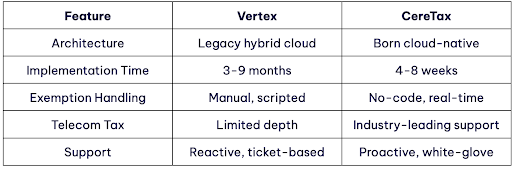
We’re not here to bash Vertex. It served its purpose for a time. But today, enterprise tax teams need more than a legacy tool retrofitted for the cloud. They need speed, agility, and lower total cost of ownership.
CereTax delivers on all three.
If you’re feeling stuck, you’re not alone. The window is open. Let’s talk about how easy it is to move forward.
[Talk to a Tax Automation Specialist]
Is CereTax a good replacement for Vertex? Yes. CereTax offers faster deployment, lower maintenance, better exemption handling, and stronger telecom tax capabilities than Vertex.
What are alternatives to Vertex tax software? CereTax is the top Vertex alternative for mid-market and enterprise companies seeking cloud-native agility and real-time tax configuration.
Why are companies leaving Vertex? Slower implementation, higher total cost of ownership, and lack of modern agility are the top reasons tax teams are switching from Vertex to CereTax.
Our complete guide to telecom tax compliance software covers what a telecom tax engine should do, the questions to ask any vendor, and how CereTax handles telecom tax.
When most businesses think of sales tax, they think of a single rate, a few exemptions, and a filing deadline. Telecom is a whole different beast.
If you provide any communications services—mobile, VoIP, IoT, managed services—you’re dealing with a mix of federal, state, local, and special district taxes layered on top of each other. Sales tax is just one piece of the puzzle, but it’s the one most likely to land you in trouble if it’s calculated wrong or applied inconsistently.
From FCC surcharges to county-level sales taxes, from streaming services to hardware bundles, the complexity isn’t just in what you sell—it’s in how it’s sold, packaged, and tracked. And that complexity is growing, fast.
Telecom providers face challenges that most other industries never have to think about:
A typical mobile package might include voice, data, messaging, hardware, and software licenses—each taxed differently. Sales tax applies differently depending on the component, the jurisdiction, and sometimes the customer’s location down to rooftop level.
A bundle that’s 20% voice today might be 5% voice in a year. If you can’t adjust your sales tax allocation quickly—and keep a record of why you did it—you’re inviting audit pain.
Two customers in the same ZIP code could be in different tax jurisdictions. That means sales tax accuracy depends on pinpoint geolocation, not just postal codes.
Whether you’re running millions of line items in a monthly bill run or processing microtransactions for IoT devices, you need speed. A slow sales tax engine can delay invoicing and cash flow.
MVNOs, MSPs, IoT providers—they all operate under “telecom,” but their sales tax rules, exemptions, and filing obligations can be wildly different.
Here’s the harsh truth: in telecom, sales tax audits are inevitable. The question is whether they’ll cost you a few hours or a few hundred thousand dollars.
Legacy systems can calculate tax, but they often can’t show how or why a decision was made months or years ago. That lack of historical traceability turns audits into slow, expensive firefights—digging through old records, filing ticket requests, and hoping someone remembers why a bundle was configured a certain way.
If you can’t produce the who, what, when, where, and why for every sales tax decision, you’re negotiating from a position of weakness.
Sales tax compliance in telecom isn’t about memorizing rates—it’s about building an infrastructure that can handle complexity, volume, and change. Start here:
Make sure you can split every package into its taxable and non-taxable parts, and apply the correct sales tax rates automatically. Bonus points if you can do it without waiting on an IT change request or a third-party consultant.
Your system should log every adjustment to product definitions, bundle splits, or tax mappings—who made the change, when, why, and what the impact was. That’s your audit shield.
If you’re an MVNO, MSP, or IoT provider, your sales tax obligations will look different from a traditional carrier’s. Use a platform that understands those sector-specific rules from day one.
High-volume bill runs shouldn’t take a day and a half. If your tax engine can’t process millions of transactions in minutes, you’re driving a horse-and-buggy in a Lamborghini world.
Telecom is evolving fast. Your sales tax platform needs the flexibility to add products, change pricing models, and adjust sourcing rules without breaking your compliance posture.
Telecom businesses don’t just need tax automation—they need sales tax automation built for telecom. CereTax delivers that with:
Break and rebuild bundles—no IT backlog, no expensive implementation team.
From hardware leases to SaaS to pre-paid voice cards, we handle every component in your offering.
Every sales tax decision is logged in detail—who made it, when, why, and what changed—so you can defend it instantly.
MVNO, MSP, IoT—we’ve onboarded them all. We know your filing obligations and exemption needs before you hit “go live.”
We process in minutes what legacy platforms take hours (or days) to run. For high-volume telecom, that’s the difference between meeting deadlines and missing revenue targets.
Telecom sales tax isn’t getting simpler. New services, new bundles, and new entrants to the market are making the compliance map more complex every quarter.
The providers who win will be the ones who treat sales tax as an infrastructure challenge, not just an accounting task—building in flexibility, audit defense, and scale from the start.
Ready to make telecom sales tax manageable? Talk to a CereTax telecom sales tax expert today—or grab our free Sales Tax Automation Checklist to see where your current system falls short.
Sales tax isn’t just about rates and returns. It’s a fast-changing compliance risk that quietly drains resources, introduces avoidable exposure, and steals time from already stretched finance teams. One wrong exemption, one misapplied rate, or one missed jurisdiction—and suddenly your team is cleaning up chaos instead of focusing on strategy.
The complexity isn’t slowing down. States are updating taxability rules faster than ever. Your product catalog is evolving. Your business model is expanding across channels, geographies, and systems. And the spreadsheet-and-support-ticket approach? It doesn’t scale.
Modern tax automation software can solve this. But only if it’s built for the way your business actually operates—not bolted on to paper over the gaps.
The right solution won’t just calculate tax correctly. It will streamline operations, reduce audit exposure, enable faster billing, and give your team confidence—not just compliance. But with every platform claiming to “automate tax,” how do you know which one can truly keep up with your complexity?
This guidebook is your go-to checklist for:
Whether you’re a CFO, controller, or systems architect, this resource is built to help you simplify complexity—and scale tax with clarity.
Start here if you’re not sure whether you need new software.
You’ve likely outgrown your platform if…
Red Flag: If even two of these apply, your tax tech isn’t just inefficient—it’s a risk multiplier. And it's slowing your team down right when you need to move faster.
Use this checklist to evaluate any sales tax solution—whether you're auditing your current provider or vetting a new one.
Your system should support sub-second tax decisions—at scale.
✓ Millisecond response time
✓ Handles multi-jurisdiction logic dynamically
✓ No latency even under high-volume loads
✓ Accurate taxability by line item, not just invoice total
Your business isn’t static—your tax logic shouldn’t be either.
✓ Configurable by product, service, location, or channel
✓ Built to manage edge cases: bundles, subscriptions, drop-ship, SaaS, etc.
✓ Adapts as your revenue model evolves
✓ Includes sourcing rules, thresholds, and exemptions
Tip: Avoid systems that force you into rigid, pre-coded tax logic.
ZIP codes won’t cut it. Rooftop accuracy is the new standard.
✓ Geospatial rooftop-level location mapping
✓ Correct tax jurisdiction selection every time
✓ Automatically adjusts for sourcing and taxability rules by state
Manual cert tracking is a liability waiting to happen.
✓ Real-time certificate capture at checkout or onboarding
✓ Built-in validation for formatting, expiration, and jurisdiction
✓ Centralized storage and version control
✓ Flags expired/missing certs before invoices go out
If it’s not traceable, it’s not defensible.
✓ Line-level audit trail for every transaction
✓ Built-in nexus, exposure, and liability dashboards
✓ Easily exportable data for reporting or filings
✓ Drill-downs available by state, customer, or SKU
Tax should live inside your workflow, not outside of it.
✓ Native or API integrations with ERP, billing, eComm, CRM
✓ Pre-built connectors for Dynamics, NetSuite, Shopify, Salesforce, etc.
✓ Scales without rework as your systems evolve
✓ No-code or low-code integration options for faster deployment
What works at $10M ARR may break at $100M.
✓ Single platform for sales tax + use tax
✓ Supports multi-entity, multi-channel, and multi-currency setups
✓ Handles new product lines, regions, or business models without custom builds
✓ Continuous regulatory updates—no manual patching required
Sales tax is too complex to navigate alone.
✓ Dedicated account manager who knows your industry
✓ Responsive team (not bots) with deep tax knowledge
✓ Proactive check-ins during critical times (filings, audits, expansions)
✓ U.S.-based support with fast SLAs
Ask Yourself: If you had a tax emergency tomorrow, would your current provider show up?
Let’s be real: you don’t just want software that works—you want software that works better than what you have now. Here’s what that looks like.
Before CereTax:
After CereTax:
Result: Zero errors, faster billing, and a tax stack that scales with your business.
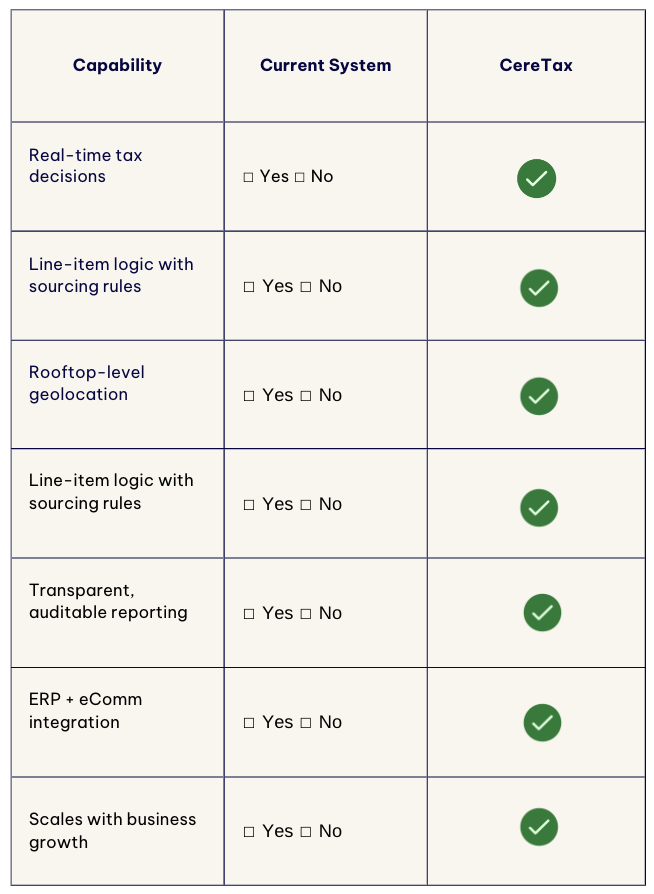
Sales tax automation isn’t just about simplifying compliance—it’s about eliminating waste, reducing audit risk, and freeing up your team to focus on the work that moves your business forward.
If your current setup is dragging your team into manual work, guesswork, or endless support tickets, it’s time for a smarter solution. CereTax is built for complexity, speed, and scale—whether you're navigating nexus in 30 states, selling across channels, or managing hundreds of exemption certificates.
Here’s how to get started:
Download the printable version of this checklist and share it with your finance, tax, or systems team. Use it to audit your current tools—or as a guide when comparing solutions.
👉 Book Your 30-minute Tax Stack Review
Sales tax mistakes aren’t always underpayments. In fact, if you’re a manufacturer, the more likely risk is that you’re paying too much.
That’s right. For all the talk about compliance gaps, audit exposure, and uncollected tax, there’s another side to the story: manufacturers routinely overpay sales tax they don’t actually owe.
It’s not because they’re careless. It’s because the system is stacked with complexity—fragmented rules, outdated exemption certificates, and platforms that don’t know the difference between a resale and a repair part.
Let’s change that.
In this guide, we’ll unpack:
If you're in finance, tax, or operations at a manufacturing business, this isn’t just about tax. It's about reclaiming margin, strengthening compliance, and freeing up time to focus on the business—not on fixing avoidable errors.
Most sales tax stories start with fear: audits, penalties, nexus, exposure. All real. All worth addressing.Manufacturers often overpay sales tax not because of noncompliance, but because complex rules and default tax logic cause exempt transactions to be taxed unnecessarily.
Most sales tax stories start with fear: audits, penalties, nexus, exposure. All real. All worth addressing.
But here’s the quieter—and more common—problem: over-collection and overpayment.
That can look like:
Unlike underpayment, overpayment doesn’t come with angry letters or interest charges. It just drains cash… quietly. Month after month. State by state.
And once that money is out the door? It’s hard to get back. Most refund claims are time-consuming, documentation-heavy, and met with resistance. Better to get it right up front.
Manufacturing sales tax exemptions exist for a reason: you’re creating value, not just consuming it. States recognize that. But taking advantage of those exemptions in practice? That’s where things break down.Manufacturers face more exemptions, more transaction complexity, and more jurisdictional variation than most businesses, making sales tax overpayment far more likely.
Manufacturing sales tax exemptions exist for a reason: you’re creating value, not just consuming it. States recognize that. But taking advantage of those exemptions in practice? That’s where things break down.
Here’s why manufacturers are especially exposed:
Manufacturers often operate across state lines—HQ in one place, distribution elsewhere, contractors in between. Each state has its own exemption rules, filing thresholds, and logic about what counts as “manufacturing.”
What’s tax-exempt in Illinois might be fully taxable in California. Use the wrong logic, and you’re either overpaying or under-collecting.
Many manufacturers buy parts, raw materials, or equipment that qualifies for exemptions under manufacturing rules or resale certificates. But those exemptions require documentation. If your system doesn’t flag them—or your vendors don’t handle certs correctly—you end up paying tax on every PO.
Bundled transactions like repair services, custom fabrication, or machinery installation often get taxed incorrectly. If your tax engine treats the entire invoice as taxable (instead of separating components), you’re probably paying too much.
Manufacturers often self-assess use tax on items that didn’t include sales tax at the point of purchase. That’s smart… until it’s over-applied. Misclassify something as taxable, and you’re voluntarily paying the state more than you owe.
Want to know if you're overpaying? Start here. These are the most commonly missed or misapplied exemptions for manufacturing businesses:
If you’re purchasing inputs that go directly into the final product, most states consider those exempt. But if your purchase descriptions are vague (or your vendor miscodes them), tax may still be applied.
Ask: Are we being charged tax on inputs that are ultimately resold?
Machinery used directly in production is exempt in many jurisdictions. But this often hinges on nuanced definitions: “direct use,” “integral to production,” etc. Miss that nuance, and your AP team might pay tax on every capital equipment purchase.
Ask: Are we validating exemption eligibility before paying equipment invoices?
In some states, electricity or natural gas used directly in manufacturing is partially or fully exempt. But most utility vendors charge tax by default—and won’t stop unless you proactively file exemption certificates.
Ask: Are we reviewing utility bills for tax on exempt energy usage?
If your packaging becomes part of the product (like shrink wrap or branded boxes), it may qualify for resale exemptions. But that’s only if you’re tracking the distinction—and your vendors are coding invoices correctly.
Ask: Are we separating exempt packaging from taxable supplies?
When selling products with installation services, many manufacturers miss the opportunity to exempt the labor portion—especially in states that tax goods but not services.
Ask: Is our system separating labor from product when calculating tax?
You might have the right logic on paper—but if your systems aren’t enforcing it consistently, it doesn’t matter.
Here’s how most manufacturers lose money without realizing it:
Exemptions get tracked in Excel. Certificates sit in shared folders. Someone forgets to flag a vendor as exempt. A new buyer miscodes a PO. It’s not malicious—it’s manual. And over time, it adds up.
Many ERP or tax systems use static rules. If a transaction falls outside of that logic—like an install bundled with a product, or a drop-ship to a tax-free jurisdiction—it gets taxed by default. The system assumes taxability. Unless someone overrides it (and most don’t).
Some businesses treat certs like a box to check. But outdated, expired, or misfiled certificates are one of the top causes of unnecessary tax payments. If your system can’t flag these issues before invoices go out or payments go through, you're bleeding cash.
Sales tax overpayment is fixable—but only if you know where to look. Here’s how high-performing finance teams start:
No need to wait for the state to call. Proactively review a sample of past invoices across vendors, states, and categories. Look for tax charged where exemptions should’ve applied. You might be shocked by how much you’re leaving on the table.
Go state-by-state and confirm that your rules reflect the current manufacturing exemptions. (And yes, they change—often quietly.) Prioritize states with the highest spend or activity.
Audit how you’re self-assessing use tax. Are you overreporting? Are categories too broad? Are taxability decisions being made by someone without clear guidance?
Dig into your exemption certificate database. Are certs up to date? Are they correctly matched to customers or vendors? If you can’t answer that in seconds, there’s work to do.
Short answer: Manufacturers may be eligible for refunds on overpaid sales or use tax, but recovery is time-limited, documentation-heavy, and often difficult to execute.
Once tax has been paid, getting it back isn’t automatic. Refund eligibility depends on:
Most states impose strict lookback windows—often three to four years—and require transaction-level documentation. As a result, many manufacturers recover only a portion of what they’re owed, or don’t pursue refunds at all.
That’s why recovery alone isn’t enough. Without fixing the root causes, the same overpayments will continue.
You don’t need a bigger tax team. You need smarter infrastructure.
Modern tax automation—like CereTax—gives manufacturers real control over tax logic, exemption handling, and compliance across every jurisdiction. Here’s what that unlocks:
Handle multi-state exemption logic with precision. Configure taxability based on product, service, geography, and context—without relying on overrides or after-the-fact edits.
Store, track, and apply exemption certificates automatically. Flag expired or missing documents before the invoice is sent or the PO is processed.
No more bouncing between systems. With ERP-connected workflows, tax gets calculated and validated where your team already works—accurately and instantly.
No black boxes. Every decision is traceable, every exemption is documented, and leadership gets a clear picture of tax exposure (or overpayment) in real time.
Manufacturing margins are tight enough. Don’t let outdated systems and manual processes eat into them.
Sales tax compliance shouldn’t just be about avoiding audits—it should be about operating smarter. That means paying exactly what you owe. No more. No less.
With the right visibility, rules, and automation in place, manufacturers can finally flip the tax conversation—from a back-office burden to a source of strategic control.
Ready to see where you stand?
CereTax helps manufacturers pinpoint overpayments, uncover missed exemptions, and fix the cracks in their tax stack—before it costs them another quarter.
CereTax. Built for the manufacturers who aren’t standing still.
Avalara just filed to go public—again. And if you’ve been a customer long enough, you already know what that usually means: rising costs, slower support, and more complexity for you to manage.
On July 21, 2025, Avalara confidentially submitted its IPO paperwork. It’s the company’s second IPO attempt since being taken private by Vista Equity in 2022 and for current users, it may be the start of another round of disruptions.
While this is a strategic move for Avalara, it signals big (and potentially costly) changes for their customers.
When a SaaS company prepares for an IPO, revenue growth becomes the name of the game. That pressure typically leads to:
We’ve seen this pattern play out across the industry. And Avalara has a history of sudden pricing shifts during major corporate transitions.
If you’re already feeling squeezed, the IPO could be the tipping point.
Going public doesn’t just affect pricing, it impacts priorities. As Avalara shifts focus to investor relations, compliance, and reporting, customer support often becomes deprioritized.
During previous transitions, users reported:
The result? More internal stress and less trust in your tax platform.
IPO processes often bring reorgs, platform changes, and shifting leadership. That kind of turbulence can slow product updates, reduce system reliability, and complicate integrations.
If you’ve already experienced inconsistent performance, those issues could grow. And you may find yourself stuck between enterprise bureaucracy and sales-driven upsells.
In short: more work for you, less value from your provider.
At CereTax, we’re not chasing Wall Street. We're laser-focused on helping our customers automate sales tax with less overhead, less stress, and no surprises.
Here’s what that looks like in practice:
And right now, we’re offering 30% off to Avalara customers who make the switch.
Avalara’s IPO isn’t just a corporate milestone, it’s a signal. Prices are likely to rise. Support will slow (even more!). And if past behavior is any indicator, customers could bear the brunt of the transition.
If you’ve been thinking about switching, now is the moment.
We’ll help you move quickly, painlessly, and without downtime.
Talk to us today to claim your 30% off.
For CFOs and finance leaders, the risk is bigger than fines or failed audits. Outdated sales tax processes drain time, obscure data, and expose the business to compliance landmines. Just ask Ideal Living, a fast-growing brand that was buried in tax errors until they automated the right way. Together we’ll unpack where those risks come from, what they’re costing your team, and how modern tax automation can flip the script.
Sales tax risk is a silent disruptor. For finance leaders, it’s about time lost, strategic momentum drained, and avoidable exposure creeping in. But it doesn’t have to be. In this guide, you’ll see how to transform tax chaos into clarity. We’ll show you:
> The hidden compliance risks most finance teams miss
> The real cost of outdated tax systems
> What modern automation unlocks (with a real-world case study)
> A CFO Risk Readiness Framework to future-proof your compliance
Sales tax doesn’t sit still. New products launch. Pricing models evolve. You enter new states, channels, or partnerships. Meanwhile, the rules change: quietly, often, and without warning. Treat sales tax like a one-time setup, and cracks start forming. Exemptions misfire. Nexus thresholds sneak past. Your logic drifts from reality. And when the numbers don’t line up at filing time, it’s already too late. Most systems won’t catch the drift. They assume tax is static. But your business isn’t. That’s why high-performing teams treat tax like a living function: monitored, tested, and built to adapt. Not a checkbox buried in a workflow.
The traps aren’t always obvious. That’s what makes them dangerous. Most sales tax mistakes happen not because someone dropped the ball, but because the system in place didn’t catch it, or wasn’t built to. Growing companies enter new markets, launch new products, or tweak pricing strategies and assume the tax logic will follow. But it doesn’t. Errors hide in the gray areas: misapplied exemptions, misunderstood product bundles, jurisdictions that weren’t mapped correctly. And when auditors come in, they don’t care how it happened. They care that it did.
When your business enters new markets—new states, new countries, new channels—your tax obligations change. But legacy systems don’t keep up. That lag creates gaps auditors love to find.
Sell a product that combines taxable and non-taxable components? If your system can’t handle split logic, you’re likely taxing wrong—and every incorrect invoice is a potential penalty.
Spreadsheets, workarounds, and disconnected systems might feel like a fix. They’re not. They open the door to human error, version control issues, and inconsistent tax logic across departments.
Use tax is one of the most misunderstood—and misapplied—areas of compliance. Underreporting it creates liabilities. Overpaying it eats into margins. Either way, it’s money lost and time wasted.
Not everything is black-and-white in tax. Complexity lives in the margins, and this is where legacy systems stumble most.
Bundled offerings often include a mix of taxable and non-taxable items. If your system applies a one-size-fits-all rule, you're either over-collecting (risking customer churn) or under-collecting (risking audit penalties).
You’re selling through marketplaces, direct-to-consumer, brick-and-mortar, and partners. Each channel may trigger different nexus or sourcing rules. If your tech isn’t built to handle this, you’re exposed.
Use tax often requires the buyer, not the seller, to calculate and remit tax. Most teams get this wrong. The result? Missed liabilities or wasted spend.
> Is shipping taxable in every state?
> What if a subscription includes both physical and digital goods?
> Who's responsible when a vendor misses tax on a drop-ship?
These aren’t hypotheticals. They’re recurring blind spots that only intelligent, adaptable systems are designed to catch.
When your systems fall short, the burden rolls downhill. Finance teams spend hours chasing inconsistencies, manually correcting invoices, and preparing for audits that shouldn’t be surprising. Instead of focusing on forecasting or strategy, they’re stuck cleaning up. And the cost of all that friction? Time, talent, and trust: all things no business can afford to waste.
Manual reconciliations that drag into the night. Invoices flagged for review…again. Hours lost piecing together fragmented tax data across platforms. A team that spends more time fixing errors than forecasting. For fast-moving finance teams, this is corrosive. Month-end becomes a war room. Strategic hires end up doing spreadsheet triage. And meanwhile, your compliance clock is ticking. Miss a filing deadline, and the penalties start stacking. Get flagged in an audit, and its reputation on the line. Every minute spent firefighting sales tax is a minute stolen from planning, growth, and execution.
One wrong jurisdiction code can blow up your whole quarter. Back taxes, penalties, and compounding interest pile on fast. And once you're on an auditor’s radar, it doesn’t stop at one mistake: they go back years, digging through every return like it’s a forensic investigation. Finance scrambles to defend filings. Legal gets pulled into damage control. Leadership demands answers. Meanwhile, your competitors are still focused on growth, and you’re explaining tax logic to a state agency. Most systems weren’t built for this level of nuance. They miss exemptions, ignore edge cases, and lag on updates. The cost of being reactive isn’t just financial; it’s strategic momentum lost.
Visibility is about more than dashboards, it’s about confidence. When your CEO needs a tax exposure breakdown before a board meeting, can your team deliver with precision and speed? Or are they combing through mismatched data across disconnected systems, hoping nothing got missed? That gap isn’t a minor inconvenience. It’s a credibility hit. And in moments like M&A, funding rounds, or IPO prep, shaky answers cost more than time, they cast doubt. Real-time visibility into tax data means faster decisions, stronger forecasts, and the confidence to move when opportunity strikes. Without it, finance becomes reactive. And reactive finance misses the window.
Legacy tax systems weren’t built for the speed, scale, or complexity of today’s business. They patch together rules, lag behind regulatory shifts, and force your team to fill in the gaps using spreadsheets, manual overrides, and late-night cleanup.
When logic breaks, visibility disappears. When support vanishes, your team becomes the front line. And when audit season hits, you’re the one scrambling to explain black-box decisions to leadership. These tools don’t just slow you down. They create risk. And the faster your business moves, the more dangerous that gap becomes.
Legacy tax platforms weren’t built for complexity. They force fast-growing companies into rigid workflows, assuming a one-size-fits-all model that doesn’t match reality. Have custom bundles, variable pricing, or overlapping tax rules across states? Too bad. Your team ends up writing manual rules, applying workarounds, or worse: ignoring edge cases entirely. That’s not just inefficient. It’s risky. Because the moment the tax logic breaks, you’re exposed… and fixing it means more manual patching.
When things go wrong, who picks up the phone? Legacy vendors are notorious for slow, ticket-based support. You submit a request, wait days, and hope someone understands your business. Meanwhile, you’re closing the books, prepping a filing, or responding to an audit notice. There’s no time for silence. Responsive, expert support isn’t a nice-to-have: it’s essential infrastructure. Without it, your finance team becomes the front line of a broken system.
Tax compliance lives and dies on data. But most legacy systems operate in silos; no shared logic between systems, no real-time visibility, and limited access to the insights that matter. You can’t reconcile what you can’t see. And when tax data is buried in black-box platforms, it’s nearly impossible to provide leadership with fast, confident answers. That lack of visibility isn’t just a reporting issue, it’s a strategic blind spot. One that grows more dangerous as your business scales.
Ideal Living was growing fast, but their tax process couldn’t keep up. As the wellness brand behind AirDoctor, AquaTru, and Aromatru expanded its B2B footprint, the Accounts Receivable (AR) team was stuck manually calculating tax for every new customer. That meant looking up rates, keying them into the system, and double-checking every entry for accuracy. It was slow. It was risky. And for 10 to 20 percent of new B2B accounts, it required monthly corrections. The team was spending more time fixing invoices than scaling the business. With plans to quadruple in size by the end of the year, that approach was unsustainable.
Ideal Living turned to CereTax, implementing an intelligent tax automation platform alongside Microsoft Dynamics 365 Business Central. In just two weeks, SKUs and customer data were loaded. Sales tax rules for food, supplements, and custom shipping methods were configured. The integration was certified, real-time, and seamless. No customizations were required.
“Of all the integrations we set up with Microsoft Dynamics 365 Business Central, CereTax was by far the most straightforward and streamlined,” said Lina Pinskaya, Controller.
From implementation to go-live, the CereTax team led training, converted mappings, and held weekly check-ins to keep the process moving. There was no guesswork, no dropped balls, just expert support and fast answers.
Once live, Ideal Living saw immediate results. Invoices no longer needed last-minute fixes. AR was no longer chasing down tax issues. The team spent less time troubleshooting and more time executing.
“We’ve seen a dramatic reduction in time spent on manual processes,” said Nini Le, Accounting Consultant. “The new system has truly streamlined our operations.”
Today, both sales and finance manage tax directly in Business Central using native workflows. They have full visibility into rules, mappings, and audit trails. If a required field is missing, the invoice gets flagged before it posts. There are no more mystery errors and no more scrambling.
With CereTax in place, Ideal Living is positioned to grow with confidence. Tax is no longer a fire drill. It is a function that runs smoothly and reliably. Behind the automation is a support team that is responsive, knowledgeable, and always available.
“Having a knowledgeable support team made all the difference,” said Pinskaya. “They were responsive to our specific questions and helped us feel supported throughout the transition and after.”
The result? Fewer errors. Faster billing. Teams that are refocused on strategic work. And a tax stack that is ready to scale with the business.
Ideal Living’s story is proof that modern tax automation isn’t just about compliance. It’s about clarity, speed, and control at scale. But transformation doesn’t start with software. It starts with asking the right questions.
These aren’t just tactical questions; they’re strategic filters. They help you spot the cracks in your current setup, ask sharper questions of your vendors, and align your team around what it actually takes to manage tax risk at scale. Use it to guide internal audits, vet new solutions, and future-proof your tech stack for what’s next.
Sales tax doesn’t care how fast you’re growing. It doesn’t care how many systems you’ve connected, how sophisticated your revenue model is, or how lean your finance team runs. It will find your weak spots…if you let it.
The truth is, most finance leaders aren’t ignoring the risk. They’re just too deep in reactive work to address it strategically. Manual reviews, surprise audits, patchwork integrations, these are symptoms of a system that’s trying to scale on a shaky foundation. And the cost is both operational and strategic. Because the time your team spends fixing tax problems is time they’re not spending driving value, advising the business, or enabling growth.
What separates high-performing teams isn’t perfection, it’s control. Clarity. The ability to see what’s coming, catch issues early, and respond with confidence. That takes more than good intentions. It takes infrastructure. Systems that are built for your complexity. Support that’s proactive and human. A tax engine that’s accurate, explainable, and always up to date.
If your current setup doesn’t give you that, it’s time to move.
CereTax was built for the companies that aren’t standing still. For the finance teams who need more than duct tape and after-the-fact fixes. With our intelligent rules engine, real-time taxability decisions, and transparent reporting, we eliminate the guesswork, the grunt work, and the hidden risks. So you can focus on what actually moves the business forward.
CereTax is built for modern complexity. With a powerful rules engine, real-time decisions, and transparent reporting, we eliminate the guesswork, grunt work, and gray areas.
We’re not just a platform. We’re a partner. One that’s fast to implement, easy to integrate, and built to scale.
Ready to see where your current setup stacks up?
Grab the CFO Risk Readiness Framework to pinpoint gaps—or talk to a tax expert who can walk you through it.
As businesses grow, so does tax complexity. New markets. New channels. More jurisdictions. Faster reporting cycles. If you’re relying on your ERP’s native indirect tax tools to keep up, you’re taking a risk.
ERP systems are powerful for core operations. But indirect tax is a different beast. It demands specialized capabilities that most ERP platforms simply can’t deliver. Here’s where they fall short, and why scalable tax compliance requires a purpose-built tax automation platform.
ERP tax compliance tools were designed to handle basic, static tax scenarios: simple sales tax calculations on standard transactions within a limited geographic footprint. They were never intended to manage the dynamic, multi-jurisdictional tax environments modern businesses face today.
As tax complexity grows, ERP-native tools fall behind. Thousands of evolving tax rules, rates, and exemptions overwhelm manual configuration processes. The tools lack the depth and flexibility needed to address complex scenarios like bundled products, usage-based taxability, cross-border sales, and industry-specific exemptions.
Manual rule maintenance becomes unmanageable. Edge cases and exceptions multiply. And as your footprint expands, keeping rates, rules, and tax treatments accurate and current becomes a constant challenge that introduces risk and inefficiency.
CereTax simplifies multi-jurisdiction complexity. Our intelligent rules engine is purpose-built to manage tax at scale. It allows tax teams to model complex taxability scenarios across jurisdictions with ease, eliminating manual processes and reducing risk.
ERP tax modules were designed for basic sales tax—calculations tied to the general ledger or invoicing, not the complexities of modern indirect tax. They lack the power of a true tax engine—one that dynamically applies evolving rules, manages exemptions, and delivers clear, auditable decisions.
Without this capability, tax teams are left in the dark. When tax decisions can’t be explained or traced, audits become high-risk and time-consuming. And as tax laws change, ERP modules can’t keep up without costly development or risky workarounds.
A true tax engine does more than calculate. It manages layered logic, adapts in real time, tracks every rule change, and delivers full transparency from calculation to audit.
CereTax provides a purpose-built tax engine with full transparency. Our platform delivers clear logic, detailed audit trails, a full history of rule changes, and rooftop-accurate jurisdiction mapping, so you can answer any question with confidence and stay audit-ready.
Many businesses try to extend their ERP’s tax capabilities with bolt-on modules or manual workarounds. These bolt-ons: third-party add-ons or custom-developed extensions—are designed to fill functional gaps in ERP-native tax tools. But they introduce complexity, risk, and hidden costs.
Patchwork add-ons typically lack deep integration with the ERP’s core data and processes, leading to inconsistent tax treatment across systems. Custom integrations require constant maintenance to keep pace with ERP upgrades and changing tax rules. Workarounds, like offline spreadsheets or manual adjustments, drain tax team bandwidth and introduce opportunities for error.
What’s more, add-ons rarely deliver the transparency, flexibility, or scalability required to maintain ERP tax compliance as the business grows. They can’t match the capabilities of a purpose-built tax automation platform, and relying on them compounds risk over time.
CereTax reduces cost and complexity. Our API-first platform integrates seamlessly with your ERP and other systems, eliminating the need for patchwork solutions and freeing your team to focus on higher-value work.
As businesses expand into new markets or add new product lines, ERP sales and use tax capabilities often become a bottleneck. These tools were never designed to handle the level of complexity and scale modern tax environments demand. ERP tax modules rely on rigid configurations that must be manually updated for each new jurisdiction or product variation. This makes them difficult to adapt quickly when entering new markets or launching new offerings.
The growing complexity of tax requirements across regions and product lines pushes ERP-native tools beyond their limits. To compensate, tax teams resort to time-consuming manual processes and constant system updates. These inefficiencies slow down expansion initiatives and heighten the risk of configuration errors and compliance gaps.
The result? Delayed launches as tax processes can’t keep pace, compliance gaps from inconsistent tax treatments, and elevated audit risk due to lack of transparency and control. These impacts don’t just affect tax, they can slow revenue recognition, erode customer trust, and stall strategic growth.
CereTax scales with your business. Our tax automation platform is built for growth. Whether you’re adding new markets, channels, or business models, CereTax gives you the flexibility and control to automate tax processes and scale without missing a beat.
ERP systems were never built to manage the demands of modern sales and use tax compliance. They handle core operations well, but indirect tax is a different challenge entirely. The growing complexity of tax rules, the need for real-time transparency, and the pressure to scale quickly all expose the limits of ERP-native tax tools.
Relying on these tools means accepting bottlenecks, manual workarounds, and audit risk… none of which belong in a modern growth strategy.
Ready to take tax compliance beyond the limits of your ERP? Let’s do this.
If you’re running a growing, complex business, you’ve likely run headfirst into a frustrating reality: the sales tax software you’re using can’t keep pace with your needs.
Legacy sales tax systems were designed for a simpler time. That was before ecommerce exploded, before omnichannel sales became standard, and before businesses sold across jurisdictions with constantly shifting rules. They were not built to handle complex product bundles, usage-based taxability, or the demand for real-time reporting and audit transparency. As a result, they force businesses into constant workarounds and manual interventions just to stay compliant.
Today, they’re forcing teams to rely on manual processes, patching together outdated integrations, and chasing down opaque tax data. All of this slows operations, increases audit exposure, and drains valuable resources.
Here’s where legacy tax systems fall short. Here is how a modern tax automation platform clears the path.
Rigid architecture that can’t adapt
Legacy tax engines are brittle by design. They rely on rigid, hard-coded logic that makes it nearly impossible to keep pace with today’s evolving business models.
Introducing new product lines. Launching subscription-based services. Expanding into new markets. Adapting to changes in shipping and fulfillment. Each of these scenarios often requires expensive custom development or a patch work of add-ons that weren’t designed to work with the tax engine.
And the stakes are high:
Every manual workaround is a potential point of failure. Every delay in adapting tax rules increases your risk of non-compliance and audit penalties. Meanwhile, tax professionals waste countless hours maintaining outdated systems instead of focusing on strategy and value-added work.
Our intelligent, adaptable rules engine lets you model even the most complex taxability scenarios with ease.
Whether it’s bundled products, usage-based tax, multi-jurisdictional sales, or emerging business models, CereTax enables you to configure and manage indirect tax logic in real time. No costly service engagements required.
The result: faster time to market, reduced risk, and more empowered tax and finance teams.
But architecture is just one part of the problem. Even when businesses can adapt their tax logic, they often find they can’t see what’s really happening.
No real-time visibility or audit readiness
Legacy tax systems turn tax data into a black box. It is opaque, fragmented, and incomplete. Teams struggle to access reliable data across systems. Reporting is often delayed, manual, or inconsistent. And when discrepancies arise, understanding the root cause is nearly impossible.
This lack of visibility doesn’t just slow down month-end close; it undermines confidence across the business. CFOs can’t get clear answers for board reporting. Tax managers can’t validate calculations before filing. And when an audit hits, the scramble begins. Teams dig through disconnected systems, trying to reconstruct a defensible audit trail under pressure.
Audit-ready reporting, clear taxability explanations, rooftop-accurate situsing with GIS technology. You can trace every decision and answer every question with confidence. Every calculation, rule, and rate is visible and explainable, giving your team control and peace of mind in any scenario.
And when visibility is limited, the challenges compound during implementation. Many teams encounter painful delays and hidden costs.
Clunky, slow implementations
Legacy tax platforms promise efficiency. In reality, implementations often drain resources for months. Custom integrations stall. Legacy architecture resists modern tech stacks. Critical data migrations break. Once live, the system demands constant care while your tax needs keep evolving.
Meanwhile, teams are stuck with delayed go-lives, missed revenue opportunities, and escalating project costs. Each update requires custom services, locking you into a cycle of dependency and frustration.
All of our APIs are purpose-built for easy integration with your existing ERPs, ecommerce platforms, and billing systems. Our modern architecture eliminates patchwork and reduces implementation timelines from months to weeks. It does this without sacrificing functionality or control.
The result? You’re up and running faster with a scalable solution that adapts as your business grows, not one that holds you back.
Even if you survive implementation, legacy systems often can’t handle today’s most critical tax scenarios.
Poor support and high cost of ownership
Legacy providers love to sell you "support," but when issues arise, getting help can feel like pulling teeth. Support tickets go unanswered. Response times drag. And when you do get help, it's often from generalists unfamiliar with your specific tax environment.
At the same time, legacy tax systems quietly drive up your total cost of ownership. Every minor configuration change comes with a new services fee. Scaling to new business units or markets triggers expensive new contracts. You're locked into an inflexible system that penalizes growth instead of enabling it.
Meanwhile, your internal teams spend more time managing vendors than managing tax compliance. This erodes trust in the platform and wastes valuable resources.
Our tax experts are with you every step of the way. They are responsive, knowledgeable, and invested in your success. We provide proactive guidance and fast answers, not canned responses. Our transparent, predictable pricing means no surprises or hidden fees. Because CereTax is built to scale with your business, your total cost of ownership stays low even as your needs evolve.
The result: a partner you can rely on, and a tax automation platform that delivers real, sustained ROI.
Legacy tax systems weren’t built for today’s complexity. The cracks are everywhere. Brittle architectures force manual workarounds. Visibility gaps put your business at audit risk. Slow implementations drain resources. Critical features like usage-based taxability remain out of reach. So-called "support" often leaves teams stranded.
Modern businesses need more. They need clarity. They need control. And they need a partner who understands the stakes and delivers. Ready to turn tax from a liability into an advantage? Let’s do this.


